Robotics & Automation Project
Hand-Gesture Controlled Car
Sep 2024 – Jan 2025
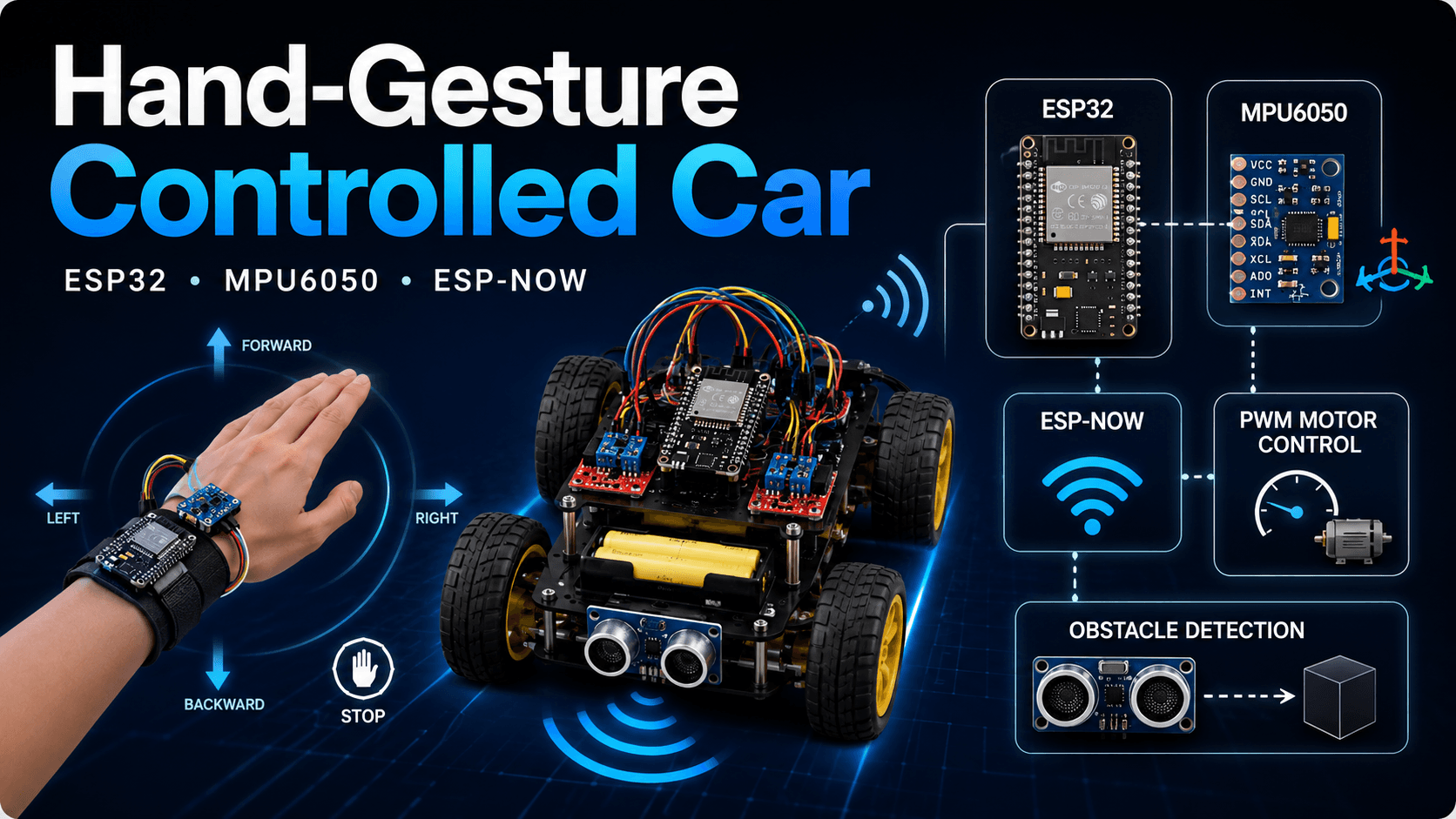
An ESP32-based gesture-controlled robotic car that translates real-time hand movements into vehicle motion commands using MPU6050 sensing, ESP-NOW wireless communication, PWM motor control, and obstacle detection.
Project Overview
This project involved the design and implementation of an intelligent human-machine interaction system using a dual ESP32 microcontroller architecture. A wearable transmitter unit captured hand gestures through an MPU6050 accelerometer and gyroscope, processed tilt-based motion data, and transmitted commands wirelessly to a vehicle receiver unit. The receiver controlled four DC motors through dual L298N drivers, allowing forward, backward, left, right, and stop commands based on real-time hand motion.
Problem Statement
Conventional remote-controlled vehicles require handheld controllers or wired command systems, which limit natural interaction and flexibility. The goal of this project was to create a more intuitive control method where vehicle movement could be directed through physical hand gestures while maintaining reliable wireless communication, safety, and responsive motor control.
Objective
To develop a gesture-controlled robotic vehicle capable of interpreting hand-tilt movements, transmitting control commands wirelessly using ESP-NOW, driving four DC motors through PWM-based motor control, and stopping automatically when an obstacle is detected in the forward path.
Methodology
- Designed a dual ESP32-based architecture consisting of a gesture transmitter unit and a vehicle receiver unit.
- Integrated an MPU6050 accelerometer and gyroscope sensor with the transmitter ESP32 to capture hand-tilt motion along the X, Y, and Z axes.
- Mapped hand gesture orientations into directional vehicle commands including forward, backward, left, right, and stop.
- Established low-latency ESP-NOW wireless communication between the transmitter and receiver ESP32 boards.
- Controlled four independent TT DC motors using dual L298N motor driver modules with PWM signals for speed and motion regulation.
- Added an HC-SR04 ultrasonic sensor for obstacle detection, triggering motor shutdown and buzzer alert when an obstacle was detected within 20 cm.
- Implemented a fail-safe inactivity timeout that stopped all motor actions if no valid gesture command was received within a defined time window.
- Applied control engineering concepts to model vehicle dynamics and develop a representative second-order system transfer function using mass, damping, and motion resistance assumptions.
Results & Outcomes
- Developed a functional gesture-controlled robotic vehicle prototype using ESP32 microcontrollers.
- Achieved real-time wireless gesture-to-motion control through ESP-NOW communication.
- Implemented forward, backward, left, right, and stop motion commands based on MPU6050 hand-tilt readings.
- Integrated obstacle detection and automatic shutdown logic using an ultrasonic sensor and buzzer warning system.
- Improved reliability through debounce delays, sensitivity tuning, and inactivity timeout-based fail-safe control.
Skills & Tools Used
Project Evidence
Prototype, Diagrams & Validation
Supporting visuals showing the project prototype, implementation details, technical diagrams, experimental work, and final outcomes.